Louisiana Dog Registration Information
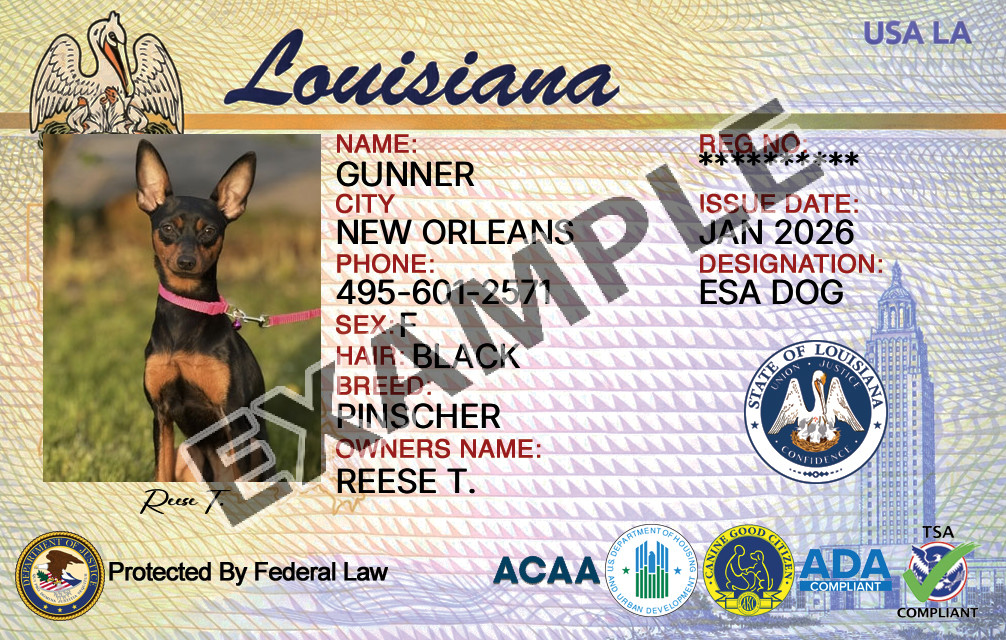
State Licensed, Service Dogs and Emotional Support Dogs in Louisiana
If you’re asking, “where do I register my dog in Louisiana for my service dog or emotional support dog?” the most important thing to know is that Louisiana generally does not have a single, statewide “service dog registration” or “ESA registration” office. In practice, what most Louisiana residents need is a dog license in Louisiana (sometimes called a rabies license or rabies tag) issued by a local parish or city animal control program.
This page explains where to register a dog in Louisiana, what “registration” really means at the local level, how rabies requirements work statewide, and how licensing differs from a dog’s status as a service dog or an emotional support animal.
A dog license (local rabies tag) is typically handled by your parish/city animal control or a contracted agency. A service dog is defined by what the dog is trained to do for a person with a disability—not by a paid online registry. An emotional support animal (ESA) is generally tied to disability-related documentation for housing—not a “license” issued by the state.
Where to Register or License Your Dog in Louisiana
Because animal control dog license Louisiana requirements are usually set and enforced locally, you’ll typically register or license your dog through the city or parish office that handles animal control, public health animal rules, and rabies enforcement. Below are several official or government-contracted examples to help you identify what the right type of office looks like. If your parish isn’t listed, look for your local “Animal Control,” “Animal Services,” “Animal Shelter & Care Center,” or “Code Enforcement” department.
East Baton Rouge Parish (City of Baton Rouge)
Animal Control & Rescue Center (ACRC)
- Address: 2680 Progress Road
- City/State/ZIP: Baton Rouge, LA 70807
- Phone: 225-774-7700
- Email: Not listed on the official contact section
- Office hours: 8 a.m.–5 p.m. Monday–Friday
Caddo Parish (Shreveport area)
Parish of Caddo — Animal Services & Mosquito Control
- Address: 1500 Monty Street
- City/State/ZIP: Shreveport, LA 71107
- Phone: (318) 226-6624
- Email: Not listed on the department contact panel
- Office hours: 10:00AM–5:00PM Monday–Friday; 11:00AM–2:00PM Saturdays (adoptions only); Closed Sunday
Orleans Parish (City of New Orleans)
Louisiana SPCA — New Orleans Campus (contracted animal control provider)
- Address: 1700 Mardi Gras Blvd.
- City/State/ZIP: New Orleans, LA 70114
- Phone: 504-368-5191
- Email: info@laspca.org
- Office hours: Wednesday–Saturday 10:00AM–5:00PM (intake/adoptions per posted service hours)
Lafayette Consolidated Government
Lafayette Animal Shelter & Care Center (LASCC)
- Address: 410 N Dugas Road
- City/State/ZIP: Lafayette, LA 70507
- Phone: 337-291-5644
- Email: LASCC@LafayetteLA.gov
- Office hours: Monday–Friday 8:00AM–4:30PM; Saturdays 12:00PM–2:00PM (adoptions only)
That’s normal. Many Louisiana parishes license dogs through different local departments (animal services, sheriff’s office support units, or a municipal shelter). If you don’t know who issues a rabies tag where you live, start with your parish/city “Animal Control” or “Animal Services” department and ask: “Where do I buy a local rabies license (dog license) tag for my address?”
Overview of Dog Licensing in Louisiana
What “registration” usually means in Louisiana
In Louisiana, when people say they need to “register” a dog, they usually mean one (or more) of the following:
- Buying a local dog license in Louisiana (often tied to rabies vaccination and displayed on the collar as a tag).
- Complying with a local ordinance (for example, leash rules, limits on number of animals, or required identification).
- Updating contact information so an animal control agency can return a found pet quickly.
Statewide rabies vaccination requirements (the baseline)
Louisiana’s public health rules require that dogs (as well as cats and ferrets) over three months of age be vaccinated against rabies by a licensed veterinarian. The rule also lays out how the initial series works and when boosters are due based on whether a 1-year or 3-year rabies vaccine was used. This statewide rule is separate from local licensing, but it’s often the foundation for local rabies tags and licensing programs.
Why local licensing exists
Local licensing helps animal control and shelters reunite lost dogs with their owners, supports rabies enforcement, and helps fund local services (like stray pickup, bite investigations, and shelter operations). That’s why many parishes treat the tag as both a public health tool and a basic registration record.
How Dog Licensing Works Locally in Louisiana
1) Find the right licensing authority for your address
Louisiana is a “local control” state for many pet rules. Depending on where you live, your animal control dog license Louisiana authority may be:
- A parish animal services department
- A city animal control program (sometimes separate from the parish)
- A city/parish animal shelter & care center
- A government-contracted animal control provider (as seen in New Orleans)
This is why the best answer to where to register a dog in Louisiana is usually: your local animal services office.
2) Confirm what type of tag or license is required
Local offices may issue:
- Rabies tags (sometimes called a “rabies license”)
- Annual dog licenses (sometimes a separate step from rabies vaccination)
- Special permits (for example, intact permits or other local permits)
If you already have a rabies certificate from your veterinarian, ask your local office whether you must also purchase a separate city/parish license tag, or whether the rabies tag functions as the license in your jurisdiction.
3) Typical steps to license your dog
- Get a current rabies vaccination from a licensed veterinarian (keep the certificate).
- Contact your local animal services office and request licensing instructions for your address.
- Submit documentation (often rabies proof and owner identification; sometimes proof of residency).
- Pay the licensing fee (amount and discounts vary by parish/city; some areas charge different fees for spayed/neutered pets).
- Receive and display the tag on your dog’s collar, and keep records in a safe place.
Rabies enforcement, bites, and why it matters
Rabies rules are enforced as a public health issue. If a dog bites a person, local protocols can include confinement/observation requirements and coordination with local health authorities. Having current rabies documentation and any required local tag can reduce delays and confusion during a stressful situation.
Service Dog Laws in Louisiana
A service dog is not created by “registration”
A service dog is generally defined by training and function: the dog is trained to do specific tasks or work for a person with a disability. A dog does not become a service dog because a website printed an ID card or added a name to a database.
What you may still need locally
Even if your dog is a legitimate service dog, local governments can still require compliance with generally applicable public health rules—like rabies vaccination—and may still require a local dog license that applies to all dogs residing in the jurisdiction. In other words:
- Service dog status relates to access rights and disability law.
- Dog licensing relates to local animal ordinances and public health enforcement.
Practical tip for service dog handlers
When you contact an office to ask where to license your dog, keep the request simple: “I need to license my dog at my address and make sure rabies records are on file.” If the staff asks whether it’s a pet, service dog, or working dog, answer honestly—but remember that the licensing process is usually the same baseline requirement.
Emotional Support Animal Rules in Louisiana
An ESA is not a “service dog,” and it’s not a state registry
An emotional support animal (ESA) typically refers to an animal that provides comfort that alleviates symptoms of a disability. ESAs are most often relevant in housing contexts (for example, requesting a reasonable accommodation). An ESA is generally not the same as a service dog trained to perform specific tasks, and an ESA does not gain legal status from an online “registration.”
What does “registration” mean for an ESA?
For an ESA in Louisiana, “registration” still usually means local licensing (rabies tag/dog license) just like any other dog. If you rent, your landlord or property manager may ask for reliable documentation supporting the accommodation request, but that is separate from the local animal control licensing process.
Best practice: separate these three concepts
| Concept | What it is | Where it’s handled |
|---|---|---|
| Dog license / rabies tag | Local record tied to vaccination and ownership; supports animal control and rabies enforcement | Usually city/parish animal services or a contracted provider |
| Service dog status | Disability-related working dog trained to perform tasks | Defined by disability law and training/function, not a state registry |
| Emotional support animal (ESA) | Disability-related support animal, most often relevant for housing accommodations | Typically handled through housing accommodation processes; still must follow local licensing and rabies rules |
Frequently Asked Questions
Do I have to register my dog with the State of Louisiana?
Usually, no single statewide “dog registry” is where most residents register pets. Louisiana’s rabies vaccination rules apply statewide, but licensing is commonly managed locally (parish/city animal services). Your best next step is contacting the local office that serves your address and asking how to obtain your local rabies tag or dog license.
Is a rabies tag the same thing as a dog license in Louisiana?
Sometimes. In many areas the rabies tag functions like a local license (or is issued as part of licensing), but in other places the city/parish may require a separate annual license tag. Always confirm with your local animal services office.
What are Louisiana’s rabies vaccination requirements for dogs?
Louisiana public health rules require that dogs over three months of age be vaccinated against rabies by a licensed veterinarian, with an initial series and boosters scheduled based on vaccine type and duration. Keep your rabies certificate—local licensing offices commonly require it to issue a tag.
Where do I register my dog in Louisiana for my service dog or emotional support dog?
Start with local licensing: contact your parish/city animal services office (or the contracted animal control provider) and request a dog license in Louisiana for your address. Service dog and ESA status are separate legal concepts and are not created by a local dog license tag—however, service dogs and ESAs generally still must meet rabies vaccination requirements and any generally applicable local licensing rules.
Should I buy an online “service dog registration” or “ESA registration”?
Be cautious. Many online registries are not government programs and do not replace a local dog license or rabies tag. If your goal is compliance, focus on (1) current rabies vaccination and (2) your local licensing authority’s process.
Register A Dog In Other Louisiana Counties
Select your county from the dropdown below to get started with your dog’s ID card. Requirements and license designs may vary by county, so choose your location to see the correct options and complete your pup’s registration.
- Acadia Dog License Cards
- Allen Dog License Cards
- Ascension Dog License Cards
- Assumption Dog License Cards
- Avoyelles Dog License Cards
- Beauregard Dog License Cards
- Bienville Dog License Cards
- Bossier Dog License Cards
- Caddo Dog License Cards
- Calcasieu Dog License Cards
- Caldwell Dog License Cards
- Cameron Dog License Cards
- Catahoula Dog License Cards
- City of Houma Dog License Cards
- Claiborne Dog License Cards
- Concordia Dog License Cards
- DeSoto Dog License Cards
- East Baton Rouge Dog License Cards
- East Carroll Dog License Cards
- East Feliciana Dog License Cards
- Evangeline Dog License Cards
- Franklin Dog License Cards
- Grant Dog License Cards
- Iberia Dog License Cards
- Iberville Dog License Cards
- Jackson Dog License Cards
- Jefferson Davis Dog License Cards
- Jefferson Dog License Cards
- Lafayette Dog License Cards
- Lafourche Dog License Cards
- LaSalle Dog License Cards
- Lincoln Dog License Cards
- Livingston Dog License Cards
- Madison Dog License Cards
- Morehouse Dog License Cards
- Natchitoches Dog License Cards
- Orleans Dog License Cards
- Ouachita Dog License Cards
- Plaquemines Dog License Cards
- Pointe Coupee Dog License Cards
- Rapides Dog License Cards
- Red River Dog License Cards
- Richland Dog License Cards
- Sabine Dog License Cards
- St. Bernard Dog License Cards
- St. Charles Dog License Cards
- St. Helena Dog License Cards
- St. James Dog License Cards
- St. John the Baptist Dog License Cards
- St. Landry Dog License Cards
- St. Martin Dog License Cards
- St. Mary Dog License Cards
- St. Tammany Dog License Cards
- Tangipahoa Dog License Cards
- Tensas Dog License Cards
- Terrebone Dog License Cards
- Union Dog License Cards
- Vermilion Dog License Cards
- Vernon Dog License Cards
- Washington Dog License Cards
- Webster Dog License Cards
- West Baton Rouge Dog License Cards
- West Carroll Dog License Cards
- West Feliciana Dog License Cards
- Winn Dog License Cards
